
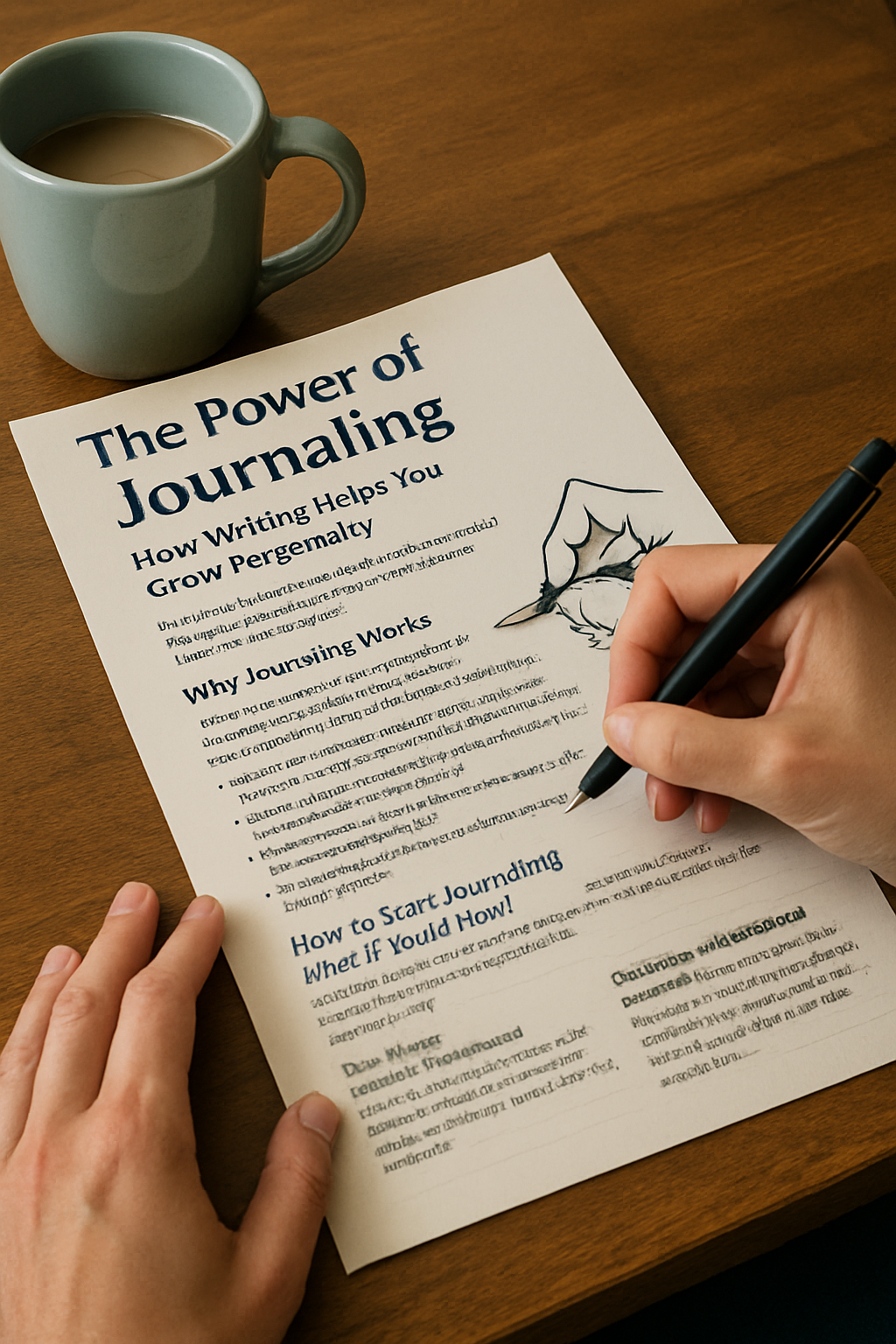
In a world full of noise and distractions, journaling offers something rare: space. A space to hear yourself. To reflect, process, dream, heal, and grow. You don’t need to be a writer to keep a journal — you just need a pen, a page, and the willingness to be honest with yourself.
In this article, you’ll discover why journaling is such a powerful tool for personal development and how to start your own practice — even if you’ve never journaled before.
Why Journaling Works
Journaling is more than just writing about your day. It’s a form of mental and emotional self-care. Here’s what it can help you do:
- Clarify your thoughts: Writing slows your thinking down so you can understand what you’re really feeling.
- Manage emotions: Journaling helps you process stress, anxiety, anger, and sadness in a healthy way.
- Track your growth: You can look back and see how far you’ve come — in mindset, habits, and healing.
- Discover patterns: You begin to recognize recurring thoughts, behaviors, and triggers.
- Connect with your goals: Writing brings your intentions into focus and keeps you accountable.
Best of all, journaling gives you a safe, judgment-free space to be fully yourself.
The Mental Health Benefits of Journaling
Many studies have confirmed that journaling can:
- Reduce symptoms of anxiety and depression
- Strengthen your immune system
- Improve sleep quality
- Increase optimism and self-esteem
- Lower stress levels
It’s like therapy on paper — and it’s free, private, and always available.
How to Start Journaling (Even if You’re New)
You don’t need a fancy notebook or perfect grammar. You just need to begin. Here are a few approaches to try:
1. Free Writing (Stream of Consciousness)
Set a timer for 5–15 minutes. Write whatever comes to mind without editing, censoring, or worrying if it makes sense.
Let your thoughts flow. If you don’t know what to write, just write “I don’t know what to write” — until something else comes out.
This clears mental clutter and helps you access deeper insights.
2. Prompt-Based Journaling
Prompts give you a starting point and help you explore specific areas of your life.
Some great prompts:
- What do I need right now that I’m not giving myself?
- What am I afraid of, and why?
- What would I do if I trusted myself more?
- What’s one thing I learned this week?
- How do I want to feel tomorrow?
Start with one prompt per day and let it guide you inward.
3. Gratitude Journaling
Write down 3–5 things you’re grateful for every day. These can be big or small — from your health to your morning coffee.
This simple habit shifts your focus from lack to abundance, and helps train your brain to see the good in everyday life.
4. Goal-Setting and Manifestation Journaling
Use your journal to visualize the life you want. Describe your goals, why they matter, and how it feels to achieve them.
Example:
“I am building a life of freedom and purpose. I wake up excited for the day. I work with creativity and intention.”
Writing in the present tense helps anchor your goals in your mind.
Make Journaling a Habit
The benefits of journaling come from consistency — not perfection. Here’s how to build the habit:
- Set a time: Morning or evening both work well. Choose when you’re least likely to be interrupted.
- Create a space: Keep your journal and pen in the same place so it’s easy to begin.
- Use triggers: Journal after a daily activity, like brushing your teeth or drinking tea.
- Start small: Even 5 minutes a day can be powerful.
Think of it as checking in with yourself — a conversation that only you can have.
What If I Don’t Know What to Write?
That’s completely normal. Here are some options to get unstuck:
- Write about how your body feels
- Describe the last dream you remember
- Make a list of things that are on your mind
- Write about a song, quote, or memory
Over time, you’ll find your flow and your own unique rhythm.
Tips for Getting the Most Out of Your Journal
- Be honest: Your journal is for you. Don’t write what sounds good — write what’s real.
- Don’t worry about spelling or structure: Messy pages are welcome.
- Re-read old entries: You’ll be surprised how much you’ve grown.
- Try different styles: Lists, poems, sketches — anything goes.
- Keep it private: This is your sacred space. No one else needs to read it.
Journaling vs. Overthinking
When you keep everything in your head, thoughts tend to swirl and amplify. But when you put them on paper, they lose their power. You create distance between yourself and your thoughts — and in that space, you can choose how to respond.
Writing helps you stop ruminating and start reflecting. It turns emotion into insight.
Final Thoughts: Your Journal Is Your Mirror
Journaling is one of the most transformative self-development tools available — and it’s available to you anytime, anywhere. It’s a practice of honesty, reflection, clarity, and courage.
You don’t need to write perfect pages.
You don’t need to have anything figured out.
Just open your journal and begin.
You might be surprised by what you discover inside yourself.